GBase 8c
Introduction
Product Overview
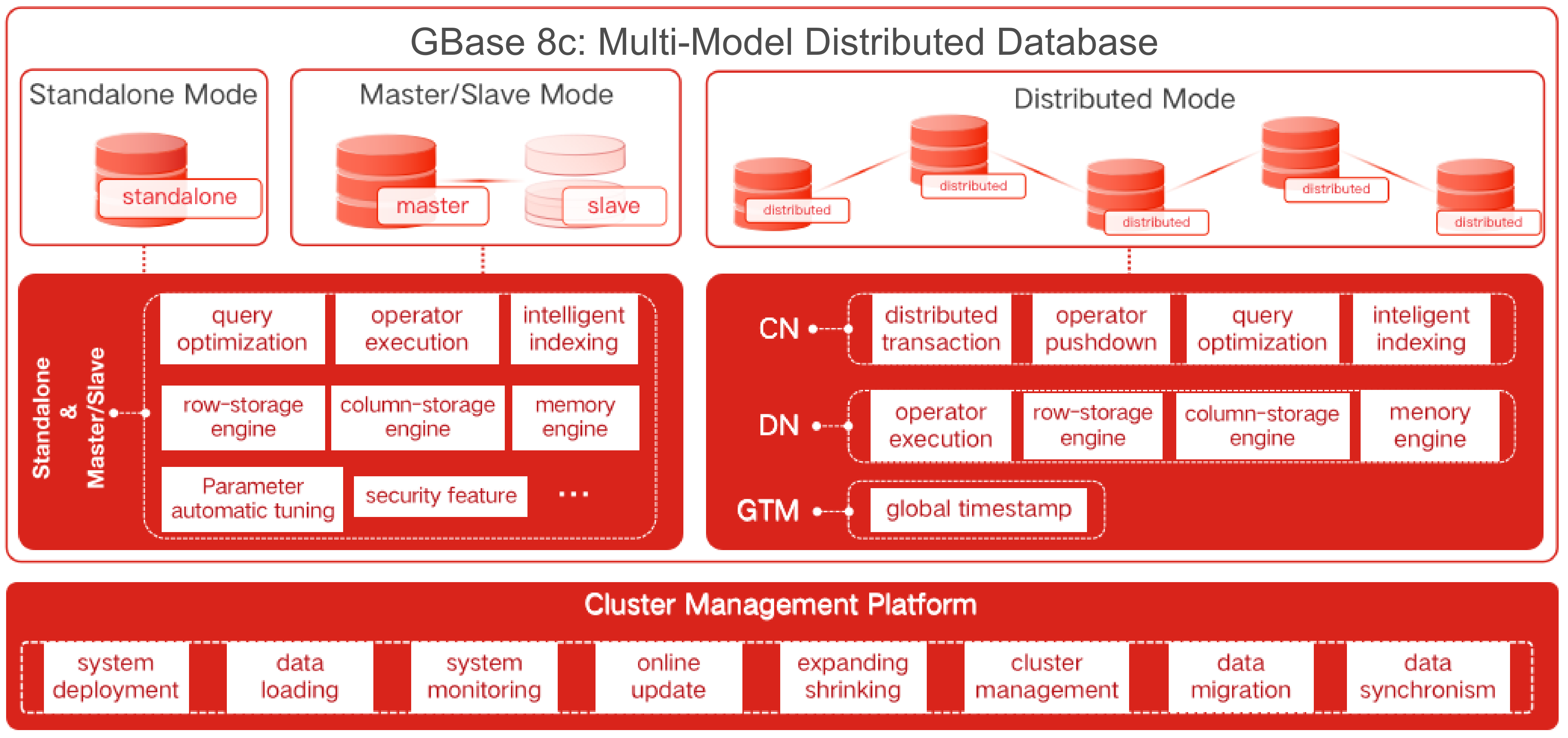
Product Architecture
- GBase 8c integrates multiple storage engines to address scenario-specific business needs:
- Row Storage Engine: Optimized for OLTP (Online Transaction Processing) scenarios such as order management, shipping systems, and banking transaction systems.
- Column Storage Engine: Designed for OLAP (Online Analytical Processing) scenarios including data statistical reporting and analysis systems.
- In-Memory Engine: Tailored for extreme-performance scenarios like bank risk control systems.
Commercial Value
Core Advantages
Multimodal & Polymorphic
Extreme Performance
Ultra-High Availability
Elastic Scalability
Ultra-High Security
Distributed Transactions
Distributed Parallel Processing
Multi-Tenancy Capability
Spatial Database Capabilities
High Compatibility
Applicable Scenarios
Core Businesses in Key Industries
- GBase 8c boasts core capabilities including strong consistency in distributed transactions, and linear scalability of computing and storage capacities.
- It supports multi-site/multi-center deployment and remote active-active mode, delivering 99.999% high availability.
- Complemented by a visual intelligent operation and maintenance (O&M) platform, the database significantly reduces customers' O&M complexity.
Internet Services
- GBase 8c's elastic scalability enables online scaling up/down based on business needs, seamlessly meeting performance requirements in extreme business scenarios.
- Its gray release feature provides robust support for the frequent deployment and decommissioning of internet services.
Government and Enterprise Services
- GBase 8c supports multiple deployment modes including physical machines, containers, private clouds, and public clouds, offering flexible options for financial businesses moving to the cloud.
- It supports data transmission encryption and storage encryption, providing strong guarantees for data security on the cloud.

Product FAQ
Explore GBase 8c's architecture, performance, deployment options, scalability, and high availability.
Q1: What is GBase 8c, and how does it differ from traditional databases?
GBase 8c is an AI-ready, multi-model database designed to support diverse data types, processing patterns, and deployment architectures. Its multi-model capabilities bring together row-oriented and column-oriented storage, hybrid transactional and analytical processing (HTAP), GIS, vector data, and time-series workloads within a unified database platform. Its flexible deployment options include primary-standby, distributed, and compute-storage disaggregated architectures.
Rather than moving data between separate systems for transactions, analytics, and AI-related workloads, GBase 8c can support these use cases on a unified platform. Applications can work with the database without needing to manage the underlying data distribution directly.
Q2: Is GBase 8c a distributed database? How much application modification is required?
Yes. GBase 8c supports a native distributed architecture in which coordinators distribute query operations to data nodes for parallel execution. Its multithreaded architecture supports concurrent workloads, while Multi-Version Concurrency Control (MVCC) helps manage concurrent reads and writes. It also supports complex cross-node JOIN queries without requiring an external middleware layer for distributed query processing.
GBase 8c is compatible with PostgreSQL syntax and offers compatibility with SQL dialects from Oracle, MySQL, and SQL Server. With the appropriate migration tools and planning, application changes can be minimized. Certain operations, such as cross-node DDL statements, may require adjustments to comply with deployment-specific execution rules.
Q3: What level of performance can GBase 8c deliver?
GBase 8c can deliver million-level TPMC performance on a single node, with distributed scaling providing additional capacity at the cluster level. In the HyBench HTAP benchmark, GBase 8c achieved an H-Score of 3810.36, demonstrating its performance in hybrid transactional and analytical workloads.
Q4: What deployment options does GBase 8c support, and how many servers are required?
GBase 8c supports several deployment models. A single-node deployment offers a simple, cost-effective starting point but does not provide high availability on its own. A primary-standby deployment uses one primary node and one or more standby nodes, with synchronous or asynchronous replication, making it suitable for workloads that prioritize single-node performance and data redundancy.
A distributed deployment uses redundant components to support high availability and can separate compute from storage. The compute-storage disaggregated model uses shared object storage and stateless compute resources, enabling rapid scaling and scale-to-zero capabilities.
For production distributed deployments, a typical minimum configuration starts with three nodes: one coordinator node (CN) and two data nodes (DNs). The final configuration should be based on the required redundancy, fault tolerance, and workload capacity.
Q5: Does GBase 8c support online scaling without disrupting business operations?
Yes. Distributed deployments support online expansion and reduction of data nodes, allowing cluster capacity to scale horizontally. Compute and storage resources can also be scaled independently where supported by the deployment architecture. Online scaling is designed to minimize data movement and reduce the impact on running workloads.
In the compute-storage disaggregated deployment model, compute capacity can be adjusted in seconds and scaled down to zero when there is no workload. This flexibility can help accommodate temporary demand spikes, such as major sales events and flash-sale traffic, while optimizing resource utilization during quieter periods.
Q6: What high-availability and disaster-recovery options does GBase 8c offer?
For primary-standby deployments, GBase 8c supports a range of high-availability and disaster-recovery topologies, including single-site deployments, dual-site configurations within the same city, two-site three-center architectures, three-site five-center architectures, and multi-site active-active deployments.
Distributed deployments also support multiple high-availability topologies, including single-site clusters, dual-center and three-center configurations within the same city, two-site three-center and two-site four-center architectures, and geographically distributed active-active deployments. The appropriate design depends on recovery objectives, network conditions, replication requirements, and application continuity needs.