[GBASE Event] ICDIS Database Parameter Tuning Competition Opens for Registration

On July 14, the "ICDIS Database Parameter Tuning Competition" hosted by GBASE, in collaboration with the Guangdong Provincial Key Laboratory of Novel Security Intelligence Technologies and Harbin Institute of Technology (Shenzhen), opens for registration. This competition will focus on the open-source database MySQL, as well as performance tuning techniques based on the GBase database platform. The event is supported by ICDIS 2022 (The 4th International Conference on Data Intelligence and Security), which will be held from August 24 to 26, 2022 in Shenzhen, China.
Competition Background
Traditional database technologies often rely on heuristic algorithms or manual intervention, such as database parameter tuning, fault diagnosis, and index recommendation. However, in the era of big data, the number of database instances is increasing, scenarios are becoming more complex, and data volumes are growing, making it difficult for traditional database technologies to meet the demands of big data. For example, cloud databases have millions of instances, and the application scenarios and user proficiency levels can vary greatly. Directly using traditional heuristic algorithms often fails to achieve satisfactory results, and manual intervention is also difficult to manage so many instances. Machine learning technology, with its strong learning capabilities, is gradually showing potential and application prospects in the database field.
Database configuration involves hundreds of adjustable system parameters that control various aspects of database components. Configuration optimization techniques improve the database's adaptability to the current scenario by selecting appropriate parameter combinations. For example, by allocating suitable memory space to various cache areas, the number of disk I/O operations can be minimized; by updating optimizer estimation metrics, the performance of plan selection can be improved. With the improvement of algorithms, the enhancement of computing power, and the transformation brought by big data, deep learning and reinforcement learning offer greater optimization potential for database optimization technologies.
Schedule
Registration and Verification (July 14 - July 31, UTC+8):
1. Registration method: Log in to the competition's official website, complete your personal information registration, and you can sign up for the competition;
2. Participants can form teams of 1-5 people, and each participant can only be part of one team;
3. Participants must ensure that the registration information is accurate and valid. The organizing committee has the right to disqualify teams that do not meet the requirements and revoke their awards;
4. The deadline for registration, team changes, and other operations is 8:00 AM on July 31;
5. Participant and team information should be filled in via Tencent Docs;
6. Please scan the QR code below to join the official competition QQ group. The latest notifications will be synchronized in the group as soon as possible.
Preliminary Round: 2022/07/16 8:00 – 2022/07/31 8:00 (UTC+8)
Description: For details of the preliminary round tasks, please refer to the "Task Description" section. Participants can submit their results during the preliminary round, and the evaluation will be conducted by the assessment system. The competition jury will review the submitted results, and the top 20 teams will be selected to enter the final round and will be announced.
One code submission opportunity is provided per day, along with running logs.
Final Round: 2022/08/04 8:00 – 2022/08/18 23:59 (UTC+8)
Description: For details of the final round tasks, please refer to the "Task Description" section. Participants can submit their results during the final round, and the evaluation will be conducted by the assessment system. The competition jury will review the submitted results, and the final 6 winning teams will be determined and announced.
Two code submission opportunities are provided per day, along with running logs.
Defense: 2022/08/24 8:00 – 2022/08/26 18:00 (UTC+8)
1. Material preparation: Teams participating in the defense must prepare review materials in advance, including code, solution ideas, and PPT materials;
2. Review meeting: It will be conducted in the form of a defense meeting, and specific arrangements will be notified separately;
3. Final ranking: The organizing committee will determine the final awards based on the teams' code, historical scores, and judges' scores, and award prizes and certificates.
Participants
Open to the whole society, personnel from higher education institutions, scientific research units, Internet enterprises, etc., can register for the competition.
Awards
First Prize: 1 team, each team will receive a prize of 10,000 yuan and a certificate;
Second Prize: 2 teams, each team will receive a prize of 5,000 yuan and a certificate;
Third Prize: 3 teams, each team will receive a prize of 2,000 yuan and a certificate;
Excellence Award: Top 20 teams in the preliminary round will receive a certificate;
Participation Award: Each participant will receive a competition-customized Kingston 32GB USB flash drive.
Encourager Program
From the launch of the competition, registered participants who successfully invite friends to participate will receive Encourager rewards. Rewards can be obtained upon meeting the invitation criteria, and gifts can be stacked without limit.
Encourager Reward - Competition-customized laptop backpack Condition - Invite 4 teams to participate
Competition Organization
Hosts:
Guangdong Provincial Key Laboratory of Novel Security Intelligence Technologies
GBASE
Harbin Institute of Technology (Shenzhen)
Co-organizers:
Guangdong Computer Society
Shenzhen Computer Society
HIT (Shenzhen)-GBASE Database Technology Joint Laboratory
Competition Steering Committee:
Huang Xuan, Secretary-General of Guangdong Computer Society
Wang Xuan, Professor at Harbin Institute of Technology (Shenzhen), Director of Guangdong Provincial Key Laboratory of Novel Security Intelligence Technologies
Mao Rui, Professor at Shenzhen University
Tang Yong, Professor at South China Normal University
Ding Mingfeng, Chairman of GBASE
Competition Organizing Committee:
Luo Wenjian, Professor at Harbin Institute of Technology (Shenzhen)
Qi Shuhan, Assistant Professor at Harbin Institute of Technology (Shenzhen), Deputy Director of HIT-GBASE Database Technology Joint Laboratory
Liu Yang, Assistant Professor at Harbin Institute of Technology (Shenzhen), Deputy Director of HIT-GBASE Database Technology Joint Laboratory
Yang Weiwei, Director of the General Engineering Office of GBASE, Deputy Director of HIT-GBASE Database Technology Joint Laboratory
Competition Expert Committee:
Xia Wen, Associate Professor at Harbin Institute of Technology (Shenzhen)
Zhao Wei, CTO of GBASE
Wang Xuesong, R&D Director of GBASE
Cui Zhiwei, Product Director of GBASE
Zhang Jiajia, Associate Researcher at Harbin Institute of Technology (Shenzhen)
Tang Bo, Assistant Professor at Southern University of Science and Technology
Qin Jianbin, Distinguished Professor at Shenzhen University
Competition Rules and Notes
Mobile devices do not support submission of competition results and score viewing. Please use a PC to submit and view.
All cheating and rule-breaking behaviors are prohibited, including but not limited to plagiarism and malicious attacks. For participants or teams suspected of cheating or rule-breaking, after verification by the competition organizer, the platform will take measures such as restricting participation or directly canceling score rankings. For specific instructions, please refer to the "Cheating and Rule-Breaking Instructions".
The competition organizer has the right to adjust and change all competition-related content, including competition rules, prize information, competition time, etc., according to the competition's operation and related needs. The final confirmation by the competition organizer shall prevail.
Preliminary Round Task Description:
Participants are required to use parameter tuning methods to improve the throughput (tps) of DBMS (MySQL 5.6) under specified workloads. Methods that can be used include but are not limited to experience-based script tuning, heuristic tuning, traditional machine learning-based tuning, and reinforcement learning-based tuning. To help participants quickly familiarize themselves with database tuning and apply it, the organizer will provide a dedicated database tuning system image. (See the task description for details)
Final Round Task Description:
The final round of this competition uses GBASE's enterprise-level distributed transactional database GBase8s as the database to be tuned. In this final round, participants are required to use a parameter tuning method to improve the throughput (tps) of GBase8s under specified workloads. Methods that can be used include but are not limited to experience-based script tuning, heuristic tuning, traditional machine learning-based tuning, and reinforcement learning-based tuning. To help participants quickly familiarize themselves with database tuning and apply it, the organizer will provide a dedicated database tuning system image. (See the task description for details)
Cheating and Rule-Breaking Instructions:
Cheating and rule-breaking in competitions are behaviors that violate the principles of fairness and justice, and improperly gain competitive advantages. They include:
(1) Plagiarism: Any competition behavior that fails to ensure originality is considered plagiarism. For example:
● Citing others' work without indicating the source at the citation;
● Continuously citing others' code exceeding 30% of the total code;
● Directly using ideas, algorithms, parameter configurations, etc., from others' blogs, GitHub, or other open-source platforms, or other channels without any original modification or processing;
● Apart from cited content, other content is insufficient to support the main contribution and value of the solution or algorithm;
● Other situations where others' results are directly used as value output rather than as tools or materials in the intermediate process of the solution (e.g., known conditions, data cleaning methods, etc.);
● Privately copying from other teams or non-team members.
(2) Unfair competition: Any behavior that does not comply with the competition's purpose and maliciously obtains high scores is considered unfair competition. For example:
● Personnel who can access competition-related data through channels other than those specified in the competition participate in the competition;
● Inviting personnel not on the team list to participate in problem-solving and solution design, or completing competition tasks outside the team through outsourcing, seeking help, etc.;
● Participants using any data other than the data provided by the competition in any form (unless explicitly allowed on the competition homepage);
● Manually labeling part or all of the test set and submitting it as a result;
● Using computing resources beyond those specified in the competition (unless not specified on the competition homepage);
● Using multiple accounts to participate in the same competition;
● Exploiting platform or rule loopholes to participate;
● Inviting personnel not on the team list to participate in problem-solving and solution design, or completing competition tasks outside the team through outsourcing, seeking help, etc.
(3) Malicious sabotage: Any behavior that damages the competition platform, evaluation system, and environment through malicious means is considered malicious sabotage. For example:
● Deliberately uploading files containing viruses;
● Deliberately launching attacks on the competition platform or evaluation system to disrupt the competition order.
Handling Measures:
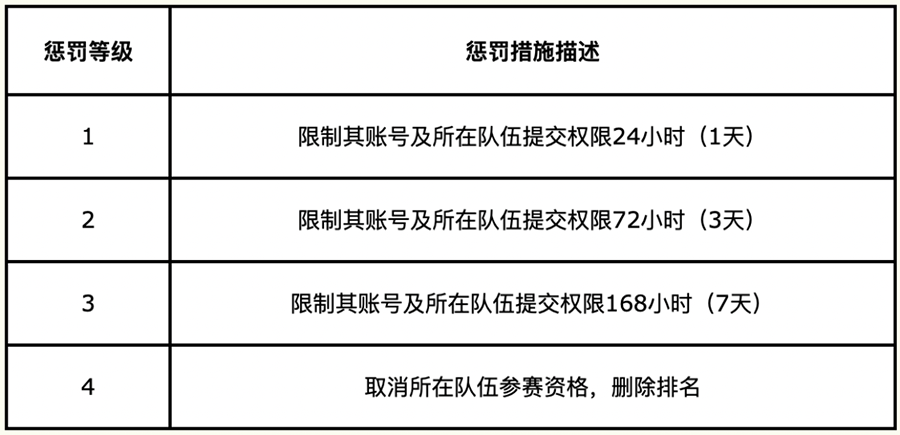
Appeal
1. Teams judged as cheating have the right to appeal. Email: [email protected];
2. When appealing, the following must be submitted, including but not limited to:
● Competition screenshots
● Detailed explanation of reasons
● Calculation code for submitted results
3. The appeal period is within 24 hours of being judged as cheating; late appeals will not be accepted;
4. The appeal result will be given within 24 hours, but the reason for the judgment will not be provided. Each team is allowed only one appeal. If the appeal fails, it will be treated as cheating and will not be modified;
5. Teams that pass the appeal will immediately have their participation rights restored and their rankings reinstated;
6. The expert judging panel of this competition has the final right to interpret the appeal results.